
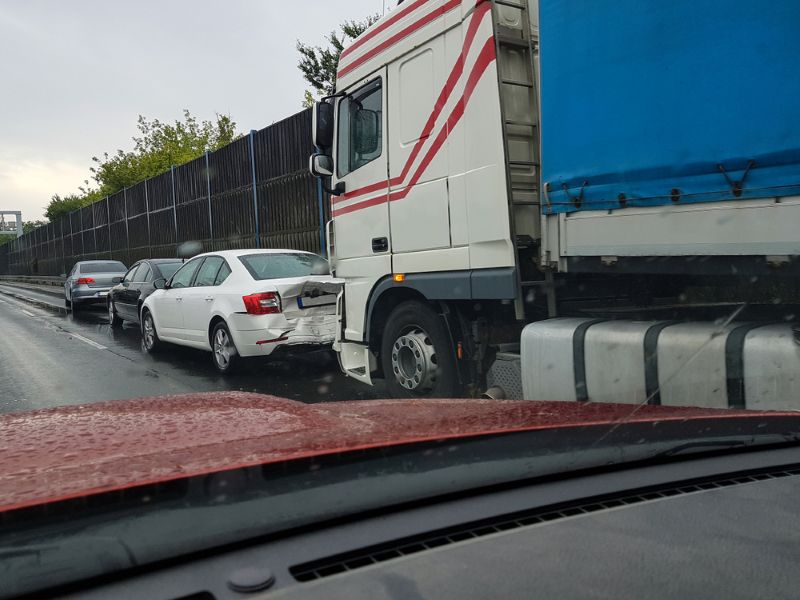
Truck Accident Liability in Chicago
Last Updated on July 1, 2026 by Patrick A. Salvi II
TL;DR
Who Can Be Held Liable in an Illinois Truck Accident
Most commercial truck crashes involve more than one liable party. A thorough investigation evaluates each of the entities below for potential direct, vicarious, or product liability. Identifying every responsible party is critical in Illinois, where modified comparative fault (735 ILCS 5/2-1116) and several liability for non-medical damages (735 ILCS 5/2-1117) directly affect recovery.
- Truck Driver — direct negligence, including Hours-of-Service violations (49 C.F.R. Part 395), distracted or impaired driving, speeding, and logbook falsification.
- Motor Carrier (trucking company) — vicarious liability under respondeat superior; direct liability for negligent hiring, training, supervision, and retention under 49 C.F.R. Parts 391 and 390.
- Truck or Trailer Owner — when ownership is split from the carrier (owner-operator leases, fleet leasing). The Graves Amendment (49 U.S.C. § 30106) may shield pure rental companies but does not protect against negligent maintenance claims.
- Freight Broker — negligent selection of an unsafe motor carrier. Viability of broker claims after Miller v. C.H. Robinson (9th Cir. 2020) depends on the F4A preemption analysis in the jurisdiction.
- Shipper — negligent loading, failure to disclose hazardous materials, or improperly sealed trailers under the Savage doctrine.
- Third-Party Cargo Loader — failure to secure cargo in compliance with 49 C.F.R. Part 393, Subpart I.
- Maintenance or Repair Contractor — negligent inspection, repair, or maintenance under 49 C.F.R. Part 396.
- Parts or Vehicle Manufacturer — product liability for defective brakes, tires, steering components, Electronic Control Modules, or underride guards.
Illinois filing window: 2 years from the date of injury (735 ILCS 5/13-202); 2 years from date of death for wrongful death (740 ILCS 180/2). Claims against a government entity — for example, defective roadway design — require 1-year notice under 745 ILCS 10/8-101.
The truck accident attorneys of Salvi, Schostok & Pritchard have been helping injured people for over 40 years and know how to prove liability in a truck accident in Chicago. Our skilled lawyers have recovered over $3.5 billion for our clients, including over 400 settlements or verdicts of $1 million or more – a testament to our deep understanding of personal injury law and our ability to win complex cases. Call now or complete our contact form to begin a free consultation with a truck accident lawyer in Chicago.
How Liability Is Proven in a Chicago Truck Accident Case
Liability for a Chicago truck crash usually comes down to negligence. Negligence is a legal term of art that means someone failed to act with reasonable care and caused harm to another person.
Anyone whose negligence or other legal fault contributes to a truck crash could be liable for the consequences. For example, a truck driver who speeds through a construction zone or drives while drowsy is acting negligently. If a driver rear-ends a car and causes severe injuries, they may be legally responsible. The trucking company could also be liable for negligently engaging in unsafe hiring or supervising practices. Furthermore, the company might be vicariously liable for the truck driver’s actions under a legal theory called respondeat superior, which holds employers responsible for the on-the-job actions of their employees. And, thanks to rules from the Federal Motor Carrier Safety Administration, trucking companies can even be liable if the negligent driver is classified as an independent contractor.
Other parties could also be liable, depending on the circumstances. These could include cargo owners and loaders, shipping agents, mechanics, truck manufacturers, component manufacturers, and other third parties. An experienced personal injury lawyer from Salvi, Schostok & Pritchard can investigate your truck accident claim to identify all parties that could be held liable for your injuries.
What Factors Impact Liability in Truck Accidents?
Several factors can influence who is responsible for a truck collision. These include the cause of the crash, the truck’s condition, the driver’s actions, and whether any companies involved violated federal or state safety rules. Investigators and truck accident lawyers must carefully review all the evidence from every angle to get a complete picture of how the crash happened and who is responsible.
Gathering Evidence to Determine Liability After a Truck Accident in Chicago
Determining fault for a truck crash can be difficult without legal assistance. To prove liability for a truck crash, you must support your legal claim with compelling evidence. Some types of evidence your legal team might use include:
- Black box data – The truck’s event data recorder can show its speed, braking patterns, and hours of operation in the hours and moments leading up to the crash. This information can help investigators determine whether the truck driver involved was speeding, failed to brake, or violated rest rules.
- Driver logs – These records track the time the driver spent on the road. If the logs show the driver exceeded legal driving hours, it can indicate driver fatigue or pressure from a trucking company to break safety regulations.
- Maintenance and inspection records – These documents may reveal whether the truck was properly maintained. Missing or delayed repairs can show that the trucking company ignored safety issues.
- Dashcam or surveillance footage – Video from the truck or nearby traffic cameras can provide a visual account of the crash and the driver’s actions, including careless actions like unsafe lane changes or merges.
- Witness statements – Testimony from drivers, passengers, or bystanders who saw the crash can support or contradict the truck driver’s version of events.
- Photos of the accident scene – Photographs can help show the presence (or lack thereof) of skid marks that may indicate distracted driving, the damage to all involved vehicles, and tire tread or other indications of mechanical issues.
Our lawyers have extensive experience handling truck accident cases and know what type of evidence is needed to prove liability.
How Liability Is Proven Against Each Party in a Chicago Truck Accident Case
“Our team analyzes the complex layers of control between drivers, trucking companies, and freight owners to hold all responsible parties accountable after a truck accident.”
— Brian Salvi, Equity Partner
Identifying every liable party is only the first step. Each entity in the TL;DR above owes a distinct duty of care, requires its own category of evidence, and raises its own set of defenses at trial. The sections below detail what our truck accident lawyers investigate when building a case against each potentially responsible party.
Truck Driver
Duty of care: A commercial driver must operate the vehicle with the reasonable care expected of a professionally licensed CDL holder and comply with the Federal Motor Carrier Safety Regulations (FMCSRs) and Illinois traffic law. Core obligations include Hours-of-Service limits (49 C.F.R. Part 395), prohibitions on impaired operation (49 C.F.R. Part 382), distracted-driving rules, and pre-trip inspection requirements (49 C.F.R. § 392.7).
Evidence used to prove negligence: Engine Control Module (“black box”) data, Electronic Logging Device records under 49 C.F.R. § 395.8, driver-facing and forward-facing dashcam footage, post-crash drug and alcohol testing under 49 C.F.R. § 382.303, the driver qualification file under 49 C.F.R. § 391.51, the driver’s Motor Vehicle Record, cell phone usage records, and dispatch communications.
Common defenses: Sudden emergency, mechanical failure attributable to a third party, and comparative fault on the part of the plaintiff or another motorist.
Motor Carrier (Trucking Company)
Duty of care: A motor carrier is vicariously liable for the negligent acts of its drivers committed within the scope of employment under respondeat superior. The carrier also owes independent direct duties under the FMCSRs, including driver qualification (Part 391), drug and alcohol testing (Part 382), entry-level driver training (Part 380), Hours-of-Service supervision (Part 395), and vehicle maintenance (Part 396). Under 49 C.F.R. § 390.5T, leased drivers are deemed statutory employees of the carrier whose operating authority they use, sharply limiting the independent-contractor defense.
Evidence used to prove negligence: The complete driver qualification file, training and orientation records, internal safety audit reports, FMCSA Safety Measurement System (SMS) BASIC scores at the time of hire and at the time of the crash, dispatch logs showing scheduling pressure that may have induced HOS violations, prior crash and citation history, and the carrier’s safety policies as written compared with how they were enforced in practice.
Common defenses: Independent contractor classification (significantly limited since the 1992 amendments to Part 390); the driver acted outside the scope of employment; the crash resulted from an unforeseeable mechanical defect. Plaintiffs’ counsel should also evaluate the strategic interaction between admitted vicarious liability and concurrent direct-negligence claims — preserving the direct-negligence theory is often essential to expand discovery into the carrier’s broader safety culture.
Truck or Trailer Owner
Duty of care: When the truck or trailer is owned by an entity separate from the operating motor carrier — common in owner-operator and fleet-leasing arrangements — the owner owes duties tied to maintenance, fitness for use, and permissive use. Pure rental and leasing companies are shielded from vicarious liability by the Graves Amendment (49 U.S.C. § 30106), but that immunity does not extend to claims for negligent maintenance or negligent entrustment.
Evidence used to prove negligence: Title and registration records, the lease agreement and whether it conformed to 49 C.F.R. Part 376, maintenance and inspection logs, and prior repair history.
Common defenses: Graves Amendment immunity for qualifying rental and leasing companies; absence of any maintenance or entrustment-related negligence by the owner; lease terms transferring full maintenance responsibility to the operating carrier.
Freight Broker
Duty of care: A freight broker that arranges for an unsafe motor carrier to transport a load may face liability for negligent selection. At minimum, a reasonable broker should verify the carrier’s active operating authority with the FMCSA, confirm valid insurance coverage under Form BMC-91, and review the carrier’s Safety Measurement System data before dispatch.
Evidence used to prove negligence: The broker’s carrier vetting and onboarding file, the carrier setup packet, insurance verification documents, FMCSA SMS BASIC data captured at the time of hire, and any prior performance issues with the carrier known to the broker.
Common defenses: Federal preemption under the Federal Aviation Administration Authorization Act (49 U.S.C. § 14501(c)(1)) is the dominant defense. The Seventh Circuit’s decision in Ying Ye v. GlobalTranz Enterprises, Inc., 74 F.4th 453 (7th Cir. 2023), held that the F4A preempts negligent selection claims against brokers and that the federal safety regulatory exception does not save those claims — creating substantial headwinds for broker liability theories in Illinois federal court. Alternative theories that may survive preemption — including claims that the defendant functioned as a de facto motor carrier, joint-venture liability, or claims arising from non-brokerage conduct — should be evaluated on a case-by-case basis.
Shipper
Duty of care: A shipper must properly classify, package, mark, and disclose its cargo, particularly hazardous materials regulated under 49 C.F.R. Parts 171–180. Under the Savage doctrine (United States v. Savage Truck Line, 209 F.2d 442 (4th Cir. 1953)), a shipper may be liable for latent loading defects that the carrier could not reasonably detect on inspection, and may also face liability when its dispatch pressure induces a driver to violate Hours-of-Service rules.
Evidence used to prove negligence: Bills of lading, hazardous-materials shipping papers, manifests and packing lists, weight tickets, and written communications showing schedule pressure or instructions to bypass safety procedures.
Common defenses: The loading defect was patent and visible on inspection, shifting responsibility to the carrier under 49 C.F.R. § 392.9; the carrier accepted the load and certified its securement.
Third-Party Cargo Loader
Duty of care: A third-party loading company must secure cargo in compliance with 49 C.F.R. Part 393, Subpart I, including the cargo securement performance criteria and minimum tiedown standards. The loader also owes a duty to distribute the load within the truck’s gross and axle weight ratings.
Evidence used to prove negligence: Loading records, photographs of the loaded and secured trailer, weight tickets and scale receipts, video from the loading facility, and specifications for the securement equipment used.
Common defenses: Final responsibility for cargo securement rested with the driver and motor carrier under 49 C.F.R. § 392.9, which requires the driver to inspect and confirm securement before operating the vehicle.
Maintenance or Repair Contractor
Duty of care: A maintenance or repair contractor must inspect, service, and repair commercial motor vehicles consistent with 49 C.F.R. Part 396 and the professional standard of care for commercial vehicle mechanics. Duties include identifying out-of-service conditions, properly documenting repairs, and using appropriate replacement parts.
Evidence used to prove negligence: Work orders, repair invoices, parts replacement records, prior service history on the tractor and trailer, and the contractor’s technician training and certifications.
Common defenses: The defect was outside the scope of the contracted work; the carrier failed to disclose the defective condition; subsequent operation or modification by the carrier caused the failure.
Parts or Vehicle Manufacturer
Duty of care: Under Illinois product liability law, manufacturers may be held strictly liable for manufacturing defects, design defects, and failure to warn. Components most often implicated in commercial truck litigation include brakes, tires, steering and coupling components, Electronic Control Modules, and rear underride guards.
Evidence used to prove negligence: Component recall history with the National Highway Traffic Safety Administration, prior similar-incident data, engineering and design specifications, internal testing records, and crash reconstruction by qualified mechanical and biomechanical experts.
Common defenses: Illinois’s product liability statute of repose under 735 ILCS 5/13-213, which generally bars suit more than 12 years after the first sale or 10 years after sale to the initial user (whichever is shorter); product misuse; substantial alteration of the product after sale; and intervening inadequate maintenance.
Identifying every liable party in a truck accident is not an academic exercise — it is the foundation of recovery. Because Illinois several liability under 735 ILCS 5/2-1117 limits a low-fault defendant’s exposure for non-medical damages, building a complete liability picture is what allows our clients to pursue the full value of their claim.
Contact a Chicago Truck Accident Attorney
Hurt in a truck crash in Chicago? You need experienced legal advocacy to pursue the full amount of compensation you deserve. Call Salvi, Schostok & Pritchard now or complete our contact form for a free consultation with a Chicago truck accident attorney.