
Ending Chicago's Hit-and-Run Epidemic
Last Updated on April 2, 2026 by Patrick A. Salvi II
Drivers flee and families grieve – but police solve fewer than 1% of cases.
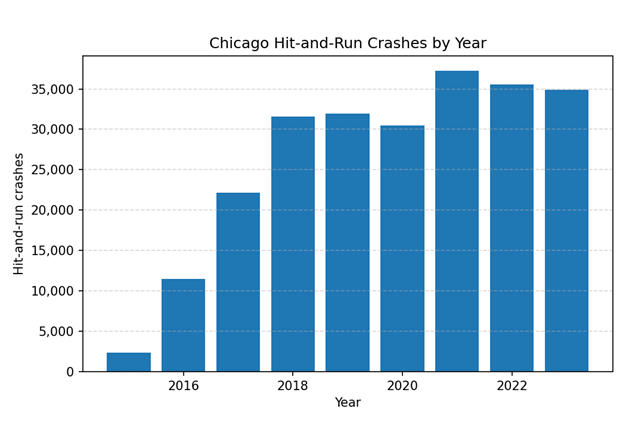
100 miles of new bike lanes have been added to the streets of Chicago as of 2025. Safer turning lanes have begun to appear in neighborhoods. More than 200 traffic cameras have been installed at dangerous intersections, and a flurry of reports now measure incremental changes across vast troves of vehicle crash data. But Chicagoans are still caught in the grip of a hit-and-run epidemic – averaging roughly 30,000 collisions annually.
Arriving via Divvy to a September press conference, Chicago Mayor Brandon Johnson touted the city’s progress.
“Since 2021, the number of traffic fatalities in Chicago has decreased by about 30%,” he told reporters.
Meanwhile, families in mourning across the city are still searching for answers from the Chicago Police Department about the startlingly low number of arrests and investigations into the hit-and-run fatalities. Above the din of applause for admirable infrastructure protections, those families’ cries can still be heard: “We can’t be OK with this.”
Read more: Jury Awards Record $79.85 Milion to Family of 10-Year-Old Killed in Vehicle Pursuit.
Families Left Stranded by the System
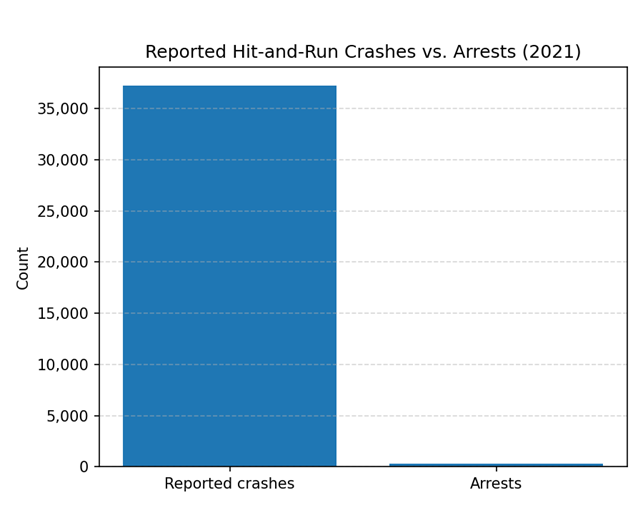
Unrelenting investigations by the Chicago Tribune and others have revealed a cruel persistence in the staggeringly high rates of traffic deaths over the past several years. In 2021 alone, 37,226 hit-and-run crashes were recorded — over 100 every single day. More than 4,800 people were injured and 36 killed, yet police made only 306 arrests — a clearance rate of 0.8%.
But behind each number is a devastated family.
On June 20, 2021, a man was driving home with his family when two men in a stolen car ran a red light at Pershing Road and State Street, crashing into the family’s vehicle. The man’s wife, Selina, 32, died on impact. Their 3-month-old son, Sebastian Jr., was rushed to Comer Children’s Hospital but died hours later.
The man and his 12-year-old son, David, survived with serious injuries. Weeks later, the grieving father struggled to fathom the catastrophe.
“To have your family gone in an instant — and over what?” he told he told NBC Chicago. “That’s something you’ll never get over.”
Credit: Salvi, Schostok & Pritchard P.C.. Data source: City of Chicago Traffic Crashes – People & Crashes; NHTSA, 2023
Just a few miles away, another family’s world was shattered on July 19, 2025. A young 22 year old woman, and her fiancé were crossing Ashland Avenue at Cullerton Street in Pilsen when the driver of an SUV, which police later described as a dark Dodge Journey, plowed into the couple and sped away. Marcela was killed. Her 21-year-old fiancé was left badly injured, lying in the street amid broken glass.
One month later, the woman’s community resorted to canvassing neighborhoods in search of information and witnesses. Clutching photos of Marcela, relatives pleaded for anyone with information to come forward and demanded justice on her behalf. Frustrated with the lack of answers, the family held a vigil in August outside of the Chicago Police’s 12th District.
“Our pain is immense, and our soul is shattered,” the young woman’s sister said at the vigil. “We’ve felt completely ignored. We’ve made calls, sent messages and still haven’t received a response.”
These families are not alone. They are among the thousands of Chicagoans who have been abandoned twice — first by fleeing drivers, then by a system that rarely delivers justice.
To get to the root of the issue, we must examine when and where hit-and-run crashes cluster in Chicago, why so few drivers are held accountable, and which proven solutions — from safer street design to traffic cameras to increased investigative resources — could finally make a difference.
Read more: Tractor Trailer Driver Awarded $12.2 Million Following Collision.
By the Numbers: A Crisis Quantified
Although Chicago’s traffic fatalities soared in 2021, Chicago Mayor Brandon Johnson said those numbers have finally started to fall.
“We aim to build upon the positive trends that we are experiencing in Chicago over the last recent years. In fact, since 2021, the number of traffic fatalities in Chicago has decreased by about 30%, even as traffic volumes picked back up after the COVID-19 pandemic,” Johnson said at a September press conference.
That decline in traffic fatalities is happening faster in the City than across most of the U.S., the mayor’s office said in an accompanying release.
Credit: Salvi, Schostok & Pritchard P.C.. Data source: City of Chicago Traffic Crashes – Crashes, 2015-2023
“Chicago is outperforming national trends, where traffic fatalities in the U.S. are estimated to be down just 8% from 2021,” the office said, “This downward trend is continuing through 2025. Preliminary data shows there were 64 traffic fatalities through the end of August, including 22 pedestrian fatalities—both are the lowest year-to-date totals in over a decade.”
For the families of some hit-and-run victims, however, the city’s efforts can never make up for their own losses.
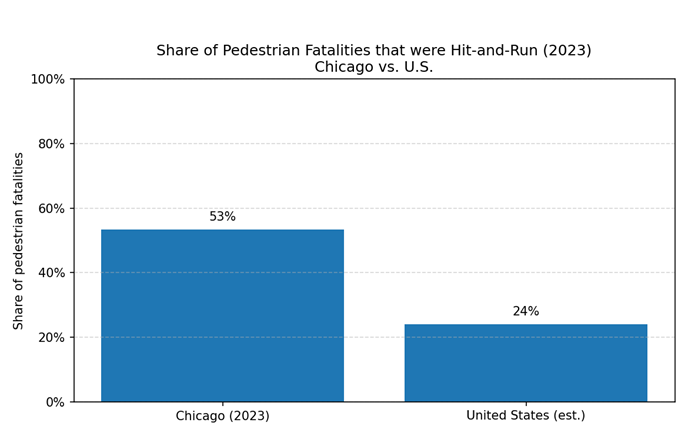
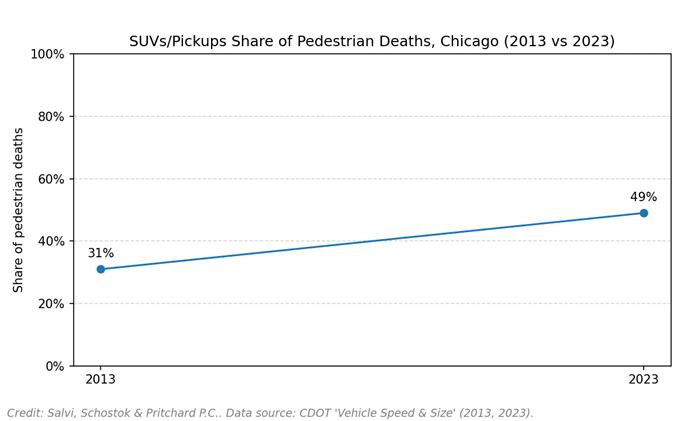
In 2023, 46 pedestrians and 10 bicyclists were killed in Chicago crashes, according to Illinois’ Department of Transportation totals. More than half of pedestrian fatalities, roughly 55%, were caused by hit-and-run drivers — over twice the U.S. average of 24%, according to the City’s Reckless Driving Data Portal. About half of the pedestrians killed were struck by SUVs or larger vehicles, according to additional City data, up from roughly a third a decade ago.
Read more: $6.6M Awarded for Injuries in Hit-and-Run.
Where Death Lurks: Mapping Traffic Fatalities
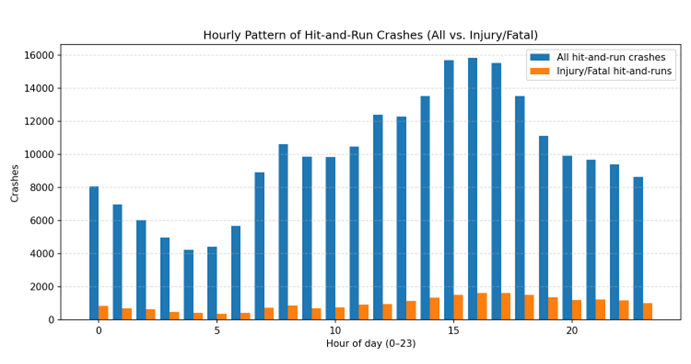
A City data analysis indicates the timing of Chicago’s hit-and-runs follows two main patterns:
- Overall crashes rise and fall with traffic volume, peaking in the afternoon and early evening, as the chart shows.
- Serious and fatal crashes are disproportionately concentrated in the late-night and early-morning hours (10 p.m.–4 a.m.), especially on Friday and Saturday nights, according to NBC5 Investigates and CPD crash analysis reports.
High-crash corridors include Western Avenue, Pulaski Road, Cicero Avenue, and Ashland Avenue — streets repeatedly flagged in Vision Zero plans as among the city’s most dangerous for pedestrians.
South and West Side neighborhoods designated as “High Crash Areas,” such as Englewood, Austin, and Washington Park, experience elevated crash and injury rates, highlighting a persistent equity gap that disproportionately impacts people of color and lower-income communities.
Residents in these communities face a brutal equation: less investment in safe infrastructure, higher traffic speeds, and demonstrably lower arrest rates for hit-and-run incidents.
Credit: Salvi, Schostok & Pritchard P.C.. Data source: City of Chicago Traffic Crashes – Crashes, 2015-2023
Left-turning city traffic has been particularly dangerous to Chicago pedestrians. The City found that “39% of crashes in 2023, that resulted in severe pedestrian injuries or fatalities at intersections, involved a left-turning motorist.”
Targeting this vein of collisions, the Transportation Department has updated safety structures for left-turning traffic at 70 intersections. The installations are aimed at slowing drivers down at crosswalks in Belmont Cragin, Englewood, Humboldt Park, Ravenswood, Archer Heights, and West Lawn.
Officials said their observations of the pilot locations installed in 2019 are now showing results. 97% of vehicles are using the newly outlined Safe Turning Zones – up from 73% of vehicles before the installations. More vehicles are also yielding to pedestrians in those areas, up to 94% compared to the previous 73%.
Read more: $1M Settlement for Man Who Suffered Shoulder Injuries in Lake County Crash
Why Most Hit-and-Run Cases Stall
“Reasons for hit and run crashes are not fully understood,” according to Chicago officials. “Some drivers flee to escape the consequences of the crash or even a separate criminal act. They may even be oblivious to the crash itself due to vehicle sightlines or other distractions.”
But individual choices don’t explain systemic failure. When fatalities peaked in 2021, police made just 306 arrests in 37,226 cases. That’s a clearance rate of less than 1%. For serious cases involving death or injury, Chicago’s clearance rate was only 9.4%, compared to 34.7% in New York City.
After a years-long public records battle with CPD officials, NBC 5 Investigates produced one of the city’s most famous investigations into deadly collisions in 2022. The news outlet found that police suspended 83.9% of fatal or serious hit-and-run incidents within just a year.
Credit: Salvi, Schostok & Pritchard P.C.. Data source: CPD Annual Report; NBC5 Investigates
Even when police reports are filed promptly and victims advocate loudly for themselves, hit-and-run crimes confront CPD with immense challenges: fleeting evidence, surveillance footage that is overwritten within 72 hours, and disappearing witnesses.
The penalties for fleeing a crash in Illinois are already in place — ranging from misdemeanors for property damage to felonies carrying up to 15 years in prison for fatal crashes. But without arrests, investigations, and follow-through, these laws serve as no deterrent whatsoever.
And while Automated License Plate Readers (ALPRs) have proven effective on Chicago’s expressways, these tools remain largely absent from the city’s surface streets, where most crashes occur.
Credit: Salvi, Schostok & Pritchard P.C.. Data source: CDOT ‘Vehicle Speed & Size’ (2013,2023).
For victims, the impact doesn’t end at the curb. The physical crash is just the beginning. Hospital bills for severe injuries routinely climb into six figures. Lost wages compound the burden. Psychological trauma requires expensive, long-term treatment.
Illinois law requires uninsured motorist coverage in every auto policy, with minimum bodily injury limits of $25,000 per person and $50,000 per accident — unchanged since 2009 despite medical inflation. But these minimums often fall far short. A single trauma surgery can exceed the entire policy limit.
Pedestrians without auto insurance face an even bleaker reality. The Illinois Crime Victim Compensation Program provides some relief, but caps medical expense payments at $45,000 for eligible crimes committed after August 2022 (previously $27,000) — barely covering the cost of an emergency room visit for serious trauma.
Read more: $45 Million Settlement for Teen Catastrophically Injured in Police Chase
What Chicago is Doing About Hit and Runs
The city’s Vision Zero initiative has redesigned some corridors with pedestrian islands, bump-outs, and raised crosswalks. Early results show promise: redesigned stretches experienced fewer serious crashes. But with only a small fraction of the 70 miles of identified high-crash corridors improved, advocates argue the pace is far too slow.
There are, however, other concrete proposals that diverse advocacy groups say could save lives immediately, including:
- Lowering the citywide speed limit from 30 mph to 25 mph. This measure has been under debate by the City Council since January 2025, despite data showing that pedestrians struck at 25 mph have a 90% survival rate, compared to 50% at 30 mph.
- Expanding the use of speed and red-light cameras in high-risk zones. Chicago currently has 162 speed cameras and 300 red-light cameras at 149 intersections, a program that started under former Mayor Rahm Emmanuel in 2013 and has been the center of strident controversy. However, those cameras have proven to be an effective tool in many cases, as almost a quarter of traffic deaths in 2023 involved a driver running a red light or stop sign, according to Vision Zero data.
- Holding Chicago law enforcement officials accountable for unpredictable, and seemingly absent, hit-and-run investigations. Some advocates suggest restoring (with enhanced public transparency) the dedicated hit-and-run investigation unit within CPD, disbanded in 2019 during budget cuts. The city could also create a public reward program for tips leading to arrests — a strategy that has tripled solve rates in other cities.
Some of these efforts are easier to implement than others, and each has its flaws. But the problem calls for a cooperative portfolio of solutions, not a silver bullet. Chicago allocates enormous resources to public safety — yet traffic enforcement receives a tiny fraction of attention and resources, despite its horrific toll.
Meanwhile, families wait for justice that never comes. Each day brings more crashes, more drivers fleeing scenes of human destruction, and more families enjoined in city-wide mourning.
Until Chicago pairs safer street design with serious traffic enforcement, hit-and-run victims and their families will remain stranded in the shadows — fighting for accountability from a system without answers.
Read more: Jury Grants $10.5M to Husband in Fatal Bicycle Accident Case
What to Do If You’re a Victim of a Hit and Run
If you’ve been injured in a hit-and-run crash, you’ll need to act promptly to ensure legal recourse and your own safety.
- Seek medical help immediately – Doing so will not harm your case or prevent you from pursuing insurance claims. Don’t hesitate to call 911. In the days and weeks following the incident, be aware of potential delayed symptoms and seek medical attention as soon as they appear. Adrenaline can mask injuries. Internal bleeding and head trauma may not show symptoms for hours or days.
- Call the police – Illinois law requires drivers to remain at the scene of a car accident and provide their information to the other parties involved. This is true even in cases involving death or personal injury. The same applies to hit-and-run incidents that only result in property damage. Drivers must also assist anyone who has been hurt. Give the police a description of the fleeing driver and their vehicle.
- Document when safe – If police have already been notified of the crash, all parties are safe, and you feel able to do so, you can then document as much as possible about the incident. Photos of the scene, your injuries, debris, and skid marks may be helpful to your attorney later. Get contact information for as many witnesses as possible. Note nearby businesses that might have surveillance cameras.
- Notify your insurance company – Your insurance company may have a narrow window of time in which you’re required to notify it of any crashes. And if you don’t notify the company promptly, you risk jeopardizing your ability to file a claim. Contact your insurance company even if the hit-and-run driver is unidentified. You can still file an uninsured motorist claim through your insurance provider. Be careful what you say to your insurance provider, though. As we’ve stated before, don’t provide a statement and don’t allow them to record it. Only tell the company there was an accident, and that the driver who hit you fled the scene.
- Consult an experienced attorney – Insurance companies often minimize payouts to hit-and-run victims. Legal representation can level the playing field when pursuing fair compensation after a crash. Even if the collision wasn’t recent, an experienced attorney may still be able to help you pursue a claim. Illinois’s statute of limitations allows a two-year period to file a personal injury lawsuit following a hit-and-run – but that limit can extend even longer if it involves minors, persons with disabilities, or injuries that show up slowly.
- Focus on your healing – Navigating insurance claims, webs of evidence, eyewitness testimony, and traffic codes can feel impossible. That’s why we’re here. Salvi, Schostok & Pritchard P.C has recovered more than $3.5 billion for Illinois injury victims and won more than 400 multi-million-dollar settlements and counting. The sooner you reach out, the sooner you can focus on your healing.
Prepared by Salvi, Schostok & Pritchard P.C., a Chicago law firm with decades of experience representing victims of serious crashes. For a detailed step-by-step resource, see our Chicago Hit-and-Run Victim Guide.
Read more: New Illinois Traffic Laws for 2025 – What You Need to Know